
College planning for divorced parents doesn’t have to mean sharing bank accounts, tax returns, or any financial details with your ex. If you’re divorced or separated and your child is applying to college, you may be surprised to learn that many private colleges require both parents to submit detailed financial information — even if you haven’t shared finances in years. This form, called the CSS Profile, asks for income, savings, and assets from each household. That means two separate financial pictures need to come together in one place to build an accurate college cost estimate for your student.
That raises a fair and understandable question: does planning for college together mean I have to share my finances with my ex? For many co-parents, that worry alone is enough to put off planning entirely, leaving the student without a clear picture of what each school will actually cost.
We didn’t want privacy to be the reason a family skips planning. That’s why we built financial privacy for separated and divorced parents directly into MyCAP — our college planning tool — where each parent controls their own financial picture. Neither parent’s income or assets are ever visible to the other, and your student still gets one complete, accurate roadmap to every school on the list.
How College Planning Works for Divorced Parents
The core idea is simple: each parent sees their own financial information, and the other parent’s financial fields display as “N/A.” Both parents still see everything that matters for the student: academic profile, school list, and your SAI or Student Aid Index, the number colleges use to estimate how much your family can contribute — that drive the whole plan. Here’s the full flow, step by step.
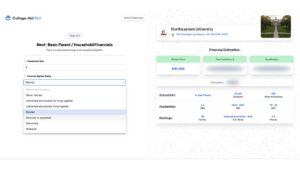
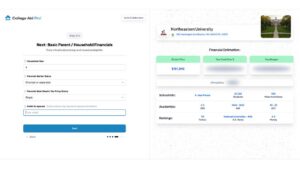
- Mark the household as Divorced/Separated
In MyCAP, when setting up your household profile (or anytime from your account settings), set your parental marital status to Divorced or separated. This single selection is what activates the financial privacy feature for both parents.
- Invite the other parent as a collaborator.
You’ll invite the other parent by email through MyCAP and assign their role. For divorced or separated families, you’ll typically select “Ex-Spouse.” (MyCAP lets you add different types of collaborators, including Student, Parent, Spouse, or Ex-Spouse — choose whichever fits your situation.) The other parent doesn’t need your login or access to your account at all.

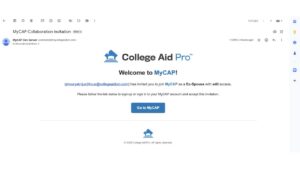
- The other parent accepts and fills in their own details.
The other parent receives the invitation email, creates their own separate MyCAP login, and fills in only their portion of the financial picture without ever touching yours. Each parent works in their own section, independently.
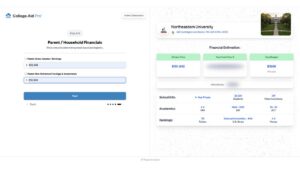
- From that point on, each parent sees only their own numbers.
You see your own financial section in full, your income, savings, and assets and it’s fully editable. Where the other parent’s financial details would appear, you simply see “N/A.” You can never accidentally view each other’s salary, savings, or investment accounts.
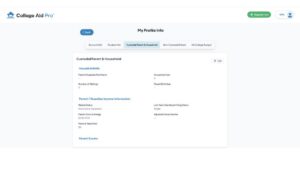
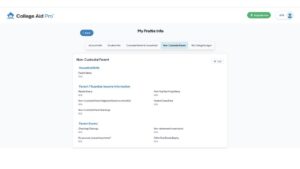
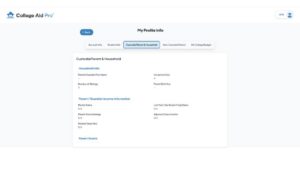
- Both parents still get the full plan.
The key outputs, the family’s SAI (your Federal and Institutional Student Aid Index, the numbers colleges use to determine aid eligibility) and the total estimated college budget — stay visible to both parents. These are the numbers you’ll actually use to compare schools and plan how to pay. They’re calculated from both parents’ complete data, but neither parent sees the other’s individual inputs.
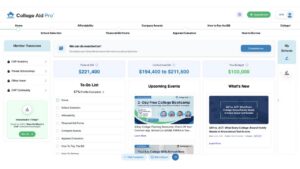
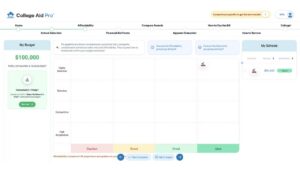
For the non-custodial parent specifically, the budget view is tailored a step further: they see the total college budget so they understand the overall picture, while the detailed breakdown lines display as “N/A” and aren’t editable. The custodial parent, meanwhile, sees the full breakdown.
You Stay in Control & Nothing Is Hidden Until You’re Ready
One detail matters more than any other, because it’s the thing that makes this feature trustworthy rather than confusing: nothing is hidden until you actually invite the other parent.
If you select Divorced/Separated but haven’t sent a collaborator invite yet, you can still view and edit the non-custodial section yourself, exactly as before. Masking only activates once two conditions are both true: you’ve marked the family as Divorced/Separated, and you’ve invited the other parent as a collaborator. Until then, you’re in full control of the whole profile.
That means you can set everything up at your own pace, see your complete plan first, and only bring the other parent in when you’re ready. There’s no surprise data lockout, and no moment where information disappears before you expected it to.
A real scenario
Maria and her ex-husband, David, have been divorced for six years. Their daughter, Sofia, is a high school junior with a strong GPA and a list of eight schools she’s excited about, several of which require the CSS Profile, which pulls in non-custodial parent information.
Maria had actually started using MyCAP months earlier, then stopped. Sound familiar? The reason wasn’t the product, it was that building a real plan meant David’s income and her income would sit in the same account, visible to both of them. After a complicated divorce, she wasn’t comfortable with that, and she assumed David would feel the same.
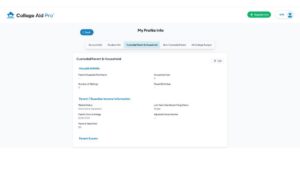
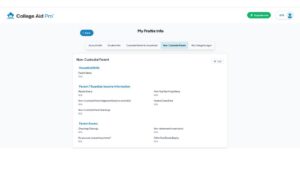
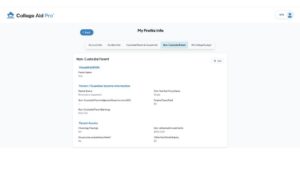
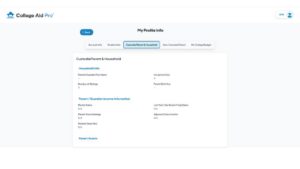
With the new privacy controls, Maria finishes her own profile, marks the household as Divorced/Separated, and invites David as a collaborator. David accepts and fills in his own financial details. Maria sees her numbers and “N/A” where David’s would be. David sees his numbers, “N/A” where Maria’s would be, and the total budget for Sofia’s plan. Neither one has to disclose anything to the other.
Maria’s View:
David’s View:
What they share is the only thing that matters: a single, accurate view of what each of Sofia’s eight schools will really cost, built from both parents’ complete data, without either parent giving up their privacy.
Why Financial Privacy Matters for Divorced Families Planning College
Separated and divorced families are not the exception when it comes to college planning. In fact they make up a significant share of the families completing the CSS Profile every year. For most of them, the financial transparency that makes a planning tool powerful has also been the biggest barrier to actually using it.
MyCAP removes that barrier. For the first time, accurate college planning and personal financial privacy aren’t a trade-off. You can have both.
Ready to Start? It’s Free.
You’ve spent years co-parenting. Now you can co-plan without giving up any financial privacy. Start building your free plan in MyCAP today, and invite the other parent only when you’re ready. Your student gets one clear, accurate roadmap to every school on the list.
Click here and start your free plan on MyCAP
Frequently Asked Questions: College Planning for Divorced Parents
Q: Do both divorced parents have to provide financial information for college applications?
A: Yes, if your child is applying to private colleges that require the CSS Profile, both the custodial and non-custodial parent are typically required to submit their financial information separately. The CSS Profile collects income, savings, and assets from both households to calculate the student’s aid eligibility.
Q: Can divorced parents plan for college without sharing their finances with each other? A: Yes. Tools like MyCAP from College Aid Pro are built specifically for this situation. Each parent fills in their own private financial section, and neither parent can see the other’s numbers. Both parents still contribute to the plan, and your student still gets a complete, accurate picture of what each school will cost.
Q: What is the difference between the custodial and non-custodial parent for college financial aid?
A: For college financial aid purposes, the custodial parent is the parent who has provided the most financial support to the student over the past 12 months, not necessarily the parent the student lives with or who has legal custody. The non-custodial parent is the other parent. For the CSS Profile, both parents must submit their own financial information separately, and schools use the combined data to estimate the total family contribution.
Q: Does the non-custodial parent have to fill out the CSS Profile?
A: In most cases, yes. Most private colleges that use the CSS Profile require both parents to complete their own section, even if the non-custodial parent is not involved in day-to-day decisions. However, there is an exception: if the student has had zero contact with the non-custodial parent, the student can request a Noncustodial Parent Waiver directly from each college they are applying to. Waiver policies vary by school, so it’s worth checking with each college’s financial aid office individually.
Shourya Kheterpal is a Product Manager at College Aid Pro, where he focuses on improving digital experiences that help families navigate college planning and financial aid with greater clarity. He is passionate about building intuitive, user-centered products that simplify complex processes.