You Submitted the FAFSA. Now What?
So you finished filling out the FAFSA. Congratulations! One more thing checked off the senior-year to-do list.
But now you’ve got a whole new set of questions. Did we get a good SAI? When do we find out how much financial aid we’re getting? And when will we actually know what it’s going to cost to send our kid to college?
If you’re the parent of a high school senior, you know this year can feel like a constant cycle of deadlines, decisions, and emotional highs and lows. Some days you’re enjoying all those senior-year moments. Other days you’re just holding on for dear life.
And no matter how many people try to prepare you for it, I don’t think anyone can fully explain what this year feels like until you’re living it.
So let’s get a few of those financial aid questions answered and take some things off that mental to-do list.
1. First, find your FAFSA Submission Summary and Student Aid Index (SAI)
Once your FAFSA has been processed, your student will have access to something called a FAFSA Submission Summary. That’s where you’ll find their official Student Aid Index, or SAI.
And if you’re thinking, Wait, I haven’t seen that yet, there’s a good reason.
Remember, the FAFSA is technically your student’s application. The notification that their FAFSA Submission Summary is available goes to the email address associated with their StudentAid.gov account, not automatically to yours.
So if you haven’t seen it, ask your kid!
Have them log into their StudentAid.gov account, find their processed FAFSA under “My Activity,” and open the FAFSA Submission Summary.
While you’re there, take a look at the information together. Make sure everything is correct and check whether there are any additional steps your student needs to complete.
Now, let’s talk about what that SAI actually means.
2. Is your SAI good or bad? And what does it actually mean?
Your Student Aid Index is just that. An index.
It’s a number colleges use to help determine how much need-based financial aid your student may be eligible to receive.
It is NOT the amount you’re expected to pay for college. And it’s not a financial aid offer.
Colleges use the SAI to calculate financial need with this formula:
Cost of Attendance − SAI = Financial Need
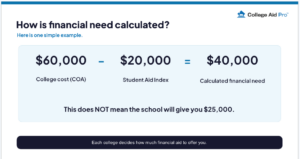
But here’s the part I really want you to understand. Just because a college calculates that your student has financial need doesn’t mean the college is going to cover all of it.
And even if the school does offer aid, it isn’t necessarily all free money. Financial aid can include grants, scholarships, work-study, and loans. Some colleges also use additional financial information to determine how much of their own institutional aid to offer.
So rather than getting hung up on whether your SAI is good or bad, think of it as one number used to help determine your student’s financial aid eligibility.
What really matters is what each college is going to offer your student and what you’ll actually have to pay.
3. Before you sit back and wait, check those college portals!
Just because the applications are submitted and the FAFSA is finished doesn’t necessarily mean you’re done with paperwork.
Some colleges require additional financial aid forms, like the CSS Profile or their own institutional forms, to determine eligibility for certain types of aid. Others may need supporting documents, additional information, or separate scholarship applications.
And where are they telling you about all of this?
Your student’s college portals and email.
Colleges are communicating with your kid (not you), so they need to be checking those accounts regularly.
Now, I’m not suggesting you take over that responsibility. But I am suggesting you ask a pretty simple question:
Hey, have you checked your college portals lately? Is there anything else they need from us?
Missing documents can delay financial aid offers. And some scholarships have separate deadlines or acceptance requirements.
I’ve heard from parents whose kids missed scholarship opportunities because they didn’t see something sitting in their college portal.
Please don’t let that happen!
4. When will you actually get your financial aid offers?
Well, just like almost every other question you’ve asked about college, the answer is…
It depends.
If your student applied Early Action or Early Decision, they may receive financial aid information earlier than students who applied Regular Decision. But that’s not always the case. Some colleges send financial aid offers around the same time as admissions decisions, while others send them separately.
Your best bet is to check each college’s financial aid website or contact the financial aid office to ask when they expect to release offers.
And there’s one really important distinction I want you to understand.
An acceptance letter is NOT necessarily your complete financial aid offer.
Even if your kid receives a merit scholarship notification with their acceptance letter, that doesn’t mean you’ve received the school’s complete financial aid offer.
The admissions office handles admission decisions. The financial aid office puts together the financial aid offer.
When that offer arrives, you’ll get a much better picture of what the college is offering your student in grants and scholarships, along with any work-study or student loans they’re eligible for.
And this is where I want you to pay attention.
Not everything listed as financial aid is free money. Grants and scholarships generally don’t have to be repaid, but loans do. And work-study is money your student earns by working, not money automatically taken off the college bill.
So don’t just look at the total financial aid number and assume that’s how much the college is taking off the price.
You’ll want to know how much of that offer is actually reducing what your family has to pay. And remember, every college may present this information a little differently, which can make comparing offers tricky.
We’ll get to how you can start preparing for that in a minute.
5. What if you made a mistake on the FAFSA?
It happens! And many mistakes can be corrected.
Once the FAFSA has been processed, review the FAFSA Submission Summary, and make eligible corrections.
But what if everything you submitted was correct and your family’s financial situation has changed?
Maybe someone lost a job, your income dropped significantly, or your family experienced unexpected expenses.
That’s a different situation, and it’s worth talking to the colleges about.
Financial aid offices can review certain special circumstances through a process called professional judgment. You may also have an opportunity to appeal your student’s financial aid offer when it arrives.
The important thing is not to assume that the numbers on your FAFSA tell your family’s entire financial story.
If something significant has changed, ask the financial aid office what your options are.
6. Do you really have to wait for financial aid offers to find out what college might cost?
NO! And please don’t wait until spring to start looking at the numbers.
The more you know now, the better prepared you’ll be when those actual offers start coming in.
If you haven’t already started estimating what the colleges on your kid’s list might cost your family, this is a great time to do it.
And if you’re wondering how to figure that out, that’s exactly why we created MyCAP, our college planning software at College Aid Pro.
MyCAP helps families estimate what different colleges might cost after potential scholarships and grants. You can see estimates of need-based aid and merit scholarships your student might qualify for and start comparing the colleges on their list.
You can create a free MyCAP account and start with three colleges. If you already have an account, now’s a good time to log back in.
Since you’ve already completed the FAFSA, check that the SAI in your MyCAP profile matches the one on your FAFSA Submission Summary. If it doesn’t, review your financial information and make any needed updates.
Then take a look at the colleges your kid is applying to. How much might each one actually cost your family?
Of course, these are estimates, not guaranteed financial aid offers. But they can help you start answering a pretty important question:
Are the colleges on our kid’s list likely to be affordable for our family?
And don’t forget, we’re not just paying for freshman year. You want to think about what those costs could look like over all four years, especially if you’re counting on financial aid to make a college affordable.
If the numbers are higher than you expected, you may still have options. Maybe there are additional scholarships your student can apply for. Maybe there’s another college worth considering if they’re still submitting applications. Or maybe you need to take a closer look at how much borrowing would be involved.
And when those actual financial aid offers arrive, MyCAP can help you compare them, understand what the colleges are offering, and start figuring out how your family could pay the bill.
That’s a whole lot better than waiting until spring and hoping the numbers work out.
Get started with MyCAP and see what the colleges on your student’s list might actually cost.
So, what’s next?
You’ve finished an important step in the financial aid process. Now make sure your student has checked their FAFSA Submission Summary, that each college has everything it needs, and that you’re staying on top of any additional deadlines.
And while you’re waiting for those financial aid offers, start looking at what the colleges on your kid’s list might actually cost.
Getting accepted to college is exciting. And it should be!
But knowing what it’s going to cost to attend is what helps your family make a good decision.
You don’t have to wait for the financial aid offers to start figuring that out.