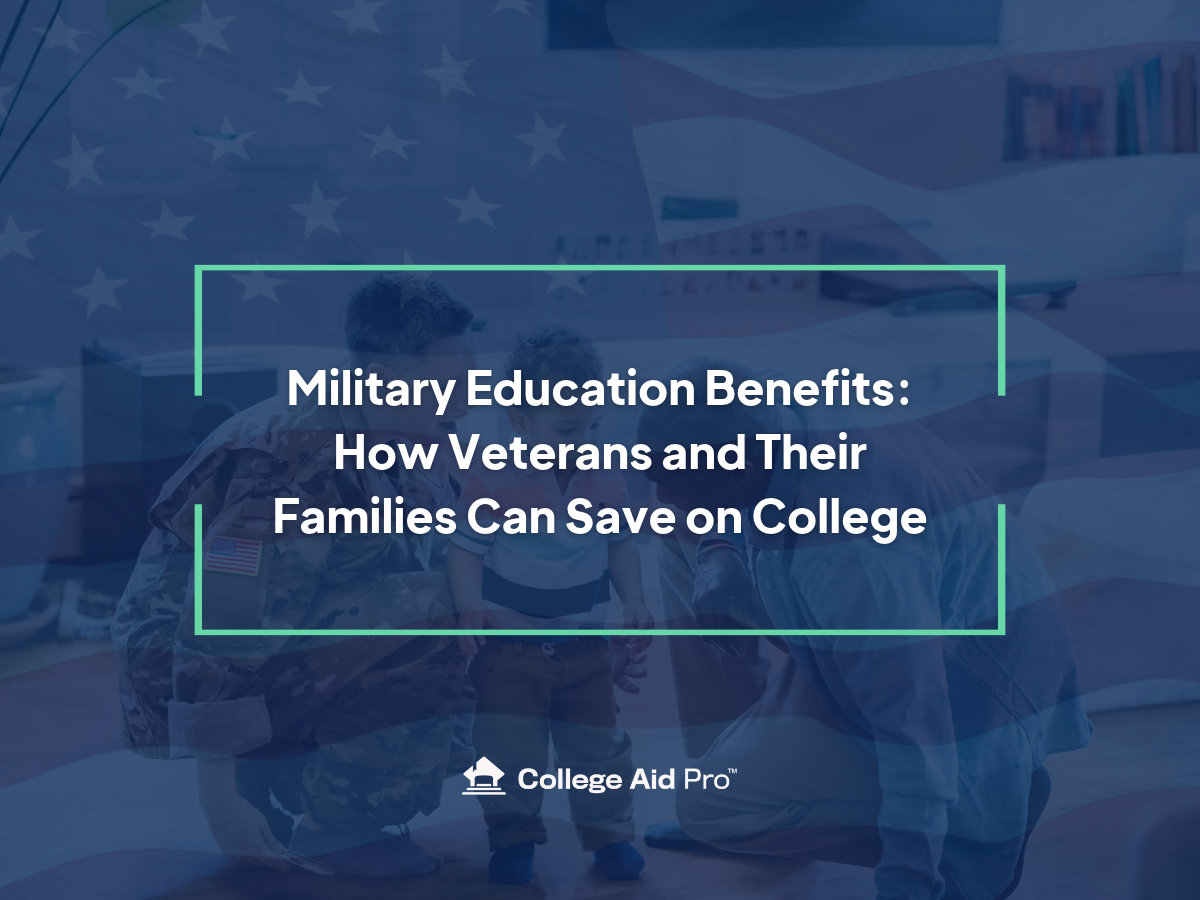
Military service can open the door to education benefits worth tens of thousands, and sometimes hundreds of thousands, of dollars.
But many veterans and military families don’t realize just how many opportunities are available to them.
Between the Post-9/11 GI Bill, Chapter 35 benefits, the Yellow Ribbon Program, state-specific tuition assistance, and scholarships, there are several ways to significantly reduce the cost of college.
The challenge? Understanding which benefits your family qualifies for, how they work together, and what steps you need to take to access them.
Learning how to maximize military education benefits can make a meaningful difference in what your family ultimately pays for college.
In This Episode of Ol’ College Try
In this episode of Ol’ College Try, College Aid Pro’s Peg Keough welcomes Mike Hunsberger, a College Aid Pro expert who spent 25 years serving in the U.S. Air Force and now works as a financial advisor.
Together, they break down the different education benefits available to veterans, active-duty service members, and their dependents.
Mike explains the differences between Chapter 33 and Chapter 35, how GI Bill benefits can be transferred to children, what the Yellow Ribbon Program covers, and why certain state programs can make public universities especially affordable.
They also discuss how military education benefits interact with merit scholarships, why some families may lose institutional aid when using VA benefits, and what parents should know before choosing a college.
The biggest takeaway? Families should research their eligibility early so they don’t miss out on valuable opportunities.
What Military Education Benefits Are Available to Veterans and Their Families?
There are several programs designed to help veterans, active-duty service members, and eligible dependents pay for higher education.
Two of the most important federal programs are:
- Chapter 33: The Post-9/11 GI Bill
- Chapter 35: Survivors’ and Dependents’ Educational Assistance (DEA)
Although both programs provide educational support, they work differently.
Eligibility, payment amounts, transferability, and the types of expenses covered depend on the program and the individual’s circumstances.
Understanding these differences is essential when building a college funding strategy.
What Is the Post-9/11 GI Bill?
The Post-9/11 GI Bill, also known as Chapter 33, is an education benefit earned through qualifying military service.
Mike explains that service members who meet the applicable service requirements may qualify for up to 36 months of education benefits.
At first, 36 months might sound like only three years of college.
But there’s an important distinction.
The VA generally calculates benefits based on the actual dates a student is enrolled in an eligible program.
Because students typically aren’t enrolled during summer and winter breaks, 36 months of entitlement can often support four traditional academic years.
What Does the GI Bill Cover?
For eligible students receiving benefits at the full rate, the Post-9/11 GI Bill can provide three major forms of financial support.
At eligible public institutions, the benefit can cover qualifying in-state tuition and mandatory fees.
Private and foreign institutions are subject to separate annual payment limits.
- Monthly housing allowance
Eligible students may receive a monthly housing allowance based on factors such as the school’s location, enrollment status, and whether courses are taken in person or online.
Mike explains that the allowance is generally tied to the military’s Basic Allowance for Housing calculation for an E-5 with dependents.
- Books and supplies stipend
Eligible students may also receive a stipend for books and supplies, generally up to $1,000 per academic year.
These benefits can substantially reduce the amount families need to pay out of pocket.
However, the exact amount depends on eligibility, enrollment, and the applicable VA rules.
Can the GI Bill Cover Four Years of College?
Yes, it can.
Mike explains that while the GI Bill generally provides up to 36 months of entitlement, those months are used based on the student’s enrollment periods.
For example, a student attending college from August through December and January through May isn’t necessarily using 12 months of benefits each calendar year.
That means a student following a traditional academic schedule may have enough entitlement to complete a four-year degree.
But families need to plan carefully.
The housing allowance generally isn’t paid during periods when the student isn’t enrolled, such as summer break.
A student living in an apartment year-round may still owe rent even when their monthly VA housing payments stop.
Understanding the payment schedule can help families budget more accurately.
How Does the Yellow Ribbon Program Work?
The Yellow Ribbon Program is especially important for families considering private colleges or institutions where tuition exceeds the standard GI Bill payment limits.
Through this program, participating colleges agree to contribute additional funding toward eligible tuition and fees.
The VA then matches the school’s contribution, subject to program rules.
For example, if a college has a tuition gap of $40,000 beyond what the GI Bill covers, the school might contribute $20,000 through Yellow Ribbon, with the VA matching that amount.
In that scenario, the remaining tuition gap could be eliminated.
However, not every college participates in the program.
And participating schools don’t necessarily offer the same amount of funding.
What Should Families Check?
Before applying to a private college, find out:
- Whether the college participates in Yellow Ribbon
- How much additional funding it provides
- Whether there is a limit on participating students
- Whether different academic programs have different funding levels
- How the school determines which eligible students receive awards
Mike emphasizes that some colleges provide enough funding to cover the full remaining tuition amount, while others offer only partial assistance.
This is one of the reasons comparing military education benefits across colleges is so important.
The same student could receive substantially different financial support depending on the institution.
Can Veterans Transfer GI Bill Benefits to Their Children?
One of the most valuable features of the Post-9/11 GI Bill is that eligible service members may be able to transfer unused benefits to a spouse or dependent children.
However, this isn’t automatic.
Mike explains that transferability generally requires the service member to meet specific service requirements and agree to additional service obligations.
Most importantly, the transfer must generally be requested and approved while the service member is still serving.
Families who wait until after retirement or separation may discover that it’s too late to initiate a transfer.
Can You Split GI Bill Benefits Between Multiple Children?
Yes.
Eligible service members can allocate portions of their available entitlement among qualifying dependents.
For example, a parent with two children might divide the available months between them.
This flexibility allows families to think strategically about how the benefit fits into their overall college funding plan.
But the allocation needs to be handled correctly.
Mike recommends confirming that the transfer has been approved and that the intended dependents have been assigned benefits before leaving military service.
What Are Chapter 35 Education Benefits?
Chapter 35, officially known as Survivors’ and Dependents’ Educational Assistance (DEA), provides education benefits to certain eligible spouses and dependents of veterans or service members.
Eligibility may apply when a service member has died under qualifying circumstances or when a veteran has a qualifying permanent and total service-connected disability.
Unlike the Post-9/11 GI Bill, Chapter 35 generally provides a monthly education payment rather than directly covering tuition and fees.
Mike discusses a monthly benefit of approximately $1,621 for eligible full-time students at the time of the episode.
The exact payment amount can change annually and depends on enrollment and eligibility.
How Long Do Chapter 35 Benefits Last?
Eligible individuals generally may receive up to 36 months of DEA benefits, although some beneficiaries are subject to different entitlement rules.
An important distinction is that eligible dependents can receive their own entitlement under Chapter 35.
The benefit isn’t necessarily divided among children in the same way a transferred GI Bill entitlement might be.
Families should confirm eligibility and payment amounts directly with the VA before incorporating the benefit into their college budget.
Can Military Families Receive In-State Tuition at Out-of-State Colleges?
This is one of the biggest potential savings opportunities Mike highlights.
Under certain federal protections, eligible students using qualifying VA education benefits may receive in-state tuition rates at public colleges even when they don’t meet the institution’s ordinary residency requirements.
That can make a substantial difference.
For example, a public university might charge $15,000 in annual tuition for in-state students but $35,000 for out-of-state students.
Qualifying for the lower rate could save a family $20,000 per year in tuition.
However, eligibility depends on the benefit being used, the student’s circumstances, and applicable federal and state requirements.
Families should never assume that all veterans or dependents automatically qualify for in-state tuition at every public institution.
Mike recommends contacting the school’s veterans benefits office to confirm the exact policy.
State Programs Can Provide Additional Savings
Beyond federal VA programs, individual states may offer their own tuition assistance, waivers, or other educational benefits for veterans and their dependents.
Mike highlights several states worth researching.
California
California offers the CalVet College Fee Waiver program for certain eligible dependents of veterans.
Qualifying students may receive a waiver of mandatory systemwide tuition and fees at participating California public institutions.
Eligibility depends on factors such as the veteran’s status, the student’s circumstances, and the applicable program requirements.
Virginia
Virginia offers the Virginia Military Survivors and Dependents Education Program (VMSDEP).
The program provides education benefits for certain eligible spouses and children of qualifying military service members and veterans.
Specific eligibility requirements and benefit rules apply.
Pennsylvania
Mike also discusses opportunities in Pennsylvania for eligible military-connected students to receive favorable tuition treatment at public institutions.
These programs can make out-of-state college options more financially attractive.
However, state policies vary significantly and may change over time.
Before relying on any state program, families should confirm the current eligibility rules, residency requirements, covered expenses, and participating institutions.
Can You Combine Military Education Benefits With Scholarships?
Potentially, yes.
And this is one of the most important parts of Peg and Mike’s conversation.
Some students may qualify for both VA education benefits and merit scholarships awarded by their college.
But that doesn’t automatically mean they can use the full value of both awards.
The college’s scholarship policies matter.
What Is Scholarship Displacement?
Scholarship displacement occurs when a college reduces one form of financial assistance after a student receives another source of funding.
Mike explains that some colleges may reduce institutional merit scholarships when VA benefits already cover tuition.
Other colleges may allow certain scholarships to be applied toward additional eligible expenses, such as housing.
For example, imagine a student receives a $20,000 merit scholarship.
If VA benefits already cover tuition, one college might reduce or eliminate the institutional scholarship.
Another college might allow the award to help cover other expenses, depending on its policies and the scholarship’s restrictions.
The financial difference could be significant.
What Should Parents Ask?
Before committing to a college, ask the financial aid office:
If my student receives VA education benefits, will that affect their merit scholarship or other institutional aid?
Also ask whether outside scholarships can be applied toward housing, meals, or other educational expenses.
Understanding these rules can help families avoid surprises and compare the true cost of different colleges.
How Do You Apply for VA Education Benefits?
Mike explains that one of the first steps is establishing eligibility through the Department of Veterans Affairs.
Eligible students can apply for education benefits through the VA.
Once the VA processes the application, it may issue a Certificate of Eligibility (COE), which documents the student’s entitlement.
The student then works with the college’s School Certifying Official to coordinate enrollment certification and benefit payments.
When Should Families Start?
Mike recommends beginning the process well before college starts.
For high school students, that might mean exploring eligibility during junior year or early senior year.
Starting early gives families time to:
- Confirm which benefits are available
- Resolve account or documentation issues
- Obtain the Certificate of Eligibility
- Understand the college’s procedures
- Plan around any benefit limitations
The process may be straightforward for some families, but others can encounter delays or complications.
Early preparation helps prevent those issues from becoming last-minute problems.
Should Veterans Benefits Influence Your College List?
Absolutely, but they shouldn’t be the only factor.
Mike explains that families should research which colleges participate in Yellow Ribbon, how they treat VA benefits, and whether students qualify for favorable tuition rates.
However, the presence of a large veterans center or additional campus services doesn’t necessarily mean a college is the best choice.
The goal is still to find a school that fits the student academically, personally, and financially.
A university with strong academic programs, a supportive environment, and favorable VA benefit policies may offer exceptional value.
But families should compare the full financial picture rather than choosing a college based on one benefit alone.
Don’t Overlook Military-Specific Scholarships
In addition to federal and state programs, there are scholarships specifically designed for veterans, active-duty service members, military spouses, and dependents.
Some are based on academic achievement.
Others consider financial need, military affiliation, service-connected disability, or other eligibility criteria.
Mike encourages families to search for scholarships that match their specific circumstances.
For example, instead of searching only for “college scholarships,” families might search for scholarships for dependents of Air Force veterans or children of disabled veterans.
A more targeted search may reveal opportunities that aren’t widely advertised.
Because these scholarships serve narrower groups of students, the applicant pool may also be smaller than for general national scholarships.
Where Can Families Find Reliable Information?
Mike’s biggest recommendation is to start with the Department of Veterans Affairs.
The VA provides information about education benefits, eligibility requirements, payment rates, approved schools, and Yellow Ribbon participation.
Families can begin at VA.gov/education.
For school-specific questions, contact the college’s veterans benefits office or School Certifying Official.
For state programs, consult the relevant state veterans affairs agency or higher education authority.
These resources can help families verify the details before making financial commitments.
The Bottom Line
Veterans and military families may have access to some of the most valuable college funding opportunities available.
But those opportunities aren’t always straightforward.
Between the Post-9/11 GI Bill, Chapter 35, Yellow Ribbon, state tuition programs, and military-specific scholarships, understanding the details can make an enormous difference.
The biggest mistake families can make is assuming they know what they’re eligible for without researching the options.
Start early. Confirm your eligibility. Understand how benefits can be transferred. Compare schools based on how they treat VA funding and scholarships.
And most importantly, don’t leave valuable military education benefits unused simply because the process seems complicated.
Your family has earned these opportunities. Taking the time to understand and maximize them can help make college significantly more affordable.