

Too Rich for Aid, Too Poor to Pay? A Former Dean Spills the Beans on How College Financial Aid Really Works
“Too rich for aid too poor to pay” is the frustrating reality for many middle-class families trying to afford college today. As tuition rises and financial aid formulas become more complex, parents often find themselves stuck earning too much to qualify for aid but not enough to comfortably pay for college.
College isn’t what it used to be.
It’s more competitive, confusing, and costly than ever.
According to the most recent College Board data, the average in-state public university is around $26k/year.
The average out-of-state public university is around $41k/year.
The average private college is around $61k/year.
Shockingly, many “highly rejective” schools (er, “highly selective”) are now more than $100k/yr.
| College Type | Average Annual Cost |
|---|---|
| In-State Public | $26,000 |
| Out-of-State Public | $41,000 |
| Private College | $61,000 |
| Highly Selective | $100,000+ |
Add in any student loan interest and it’s even worse.
These are astonishing numbers!
Ugh.
To add insult to injury, the college financial aid system – which is supposed to help – seems designed to punish hardworking parents
Many parents face the frustrating reality that they earn too much to qualify for financial aid but not enough to comfortably write a six-figure tuition check.
They appear wealthy on paper, yet the rising cost of college makes paying for it feel impossible.
Parents like this are, as I say in my new book, Too Rich for Aid, Too Poor to Pay.
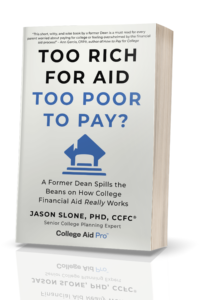
How Financial Aid Really Works
Why Does It Cost So Much?
The truth is that college doesn’t have to cost that much. After financial aid discounts are considered, most parents end up paying a lower net price than the school’s advertised sticker price.
Yes, even high-income families.
Many colleges use financial aid as a pricing tool, like coupons in business. They have a high sticker price but then discount it to a lower price to make you think you’re getting a good deal.
Why do they do this?! There are two reasons.
Reason #1 – Prestige
The higher the price, the more prestigious they look. This marketing trick is famously known as the “Chivas Regal effect” (the technical term is “price-quality heuristic”).
Chivas Regal was always a mid-market whiskey. A few years ago, they raised their prices (without changing the product). Suddenly people started thinking of it as “top shelf” because people assume price equals quality.
But it’s a marketing trick.
The same is true for colleges. They raise their prices to make you think it’s higher quality. And almost all universities are doing it.
How do I know? I was a Dean!
Reason #2 – Emotions
The second reason colleges have high prices is emotions.
Many colleges will raise their prices and then discount those prices with big scholarships because that makes you feel good.
Getting a big scholarship makes you proud of your kid. “OMG, my daughter got a $100k scholarship to Overpriced U!”
And you should be proud.
BUT… buyer beware. It’s a bit of a sales trick.

Consider this. If your student applies to a school that is $75k/year, and gets offered a $25k/year scholarship, you’re still on the hook for $50k/year.
Yes, colleges play these pricing games.
How do I know? I was a Dean!
The 6-Step College Affordability Plan
So What Can You Do? The 6-Step “College Affordability Plan”
To avoid going broke from putting your kids through college, you need to know (1) how the system works, and (2) make a plan.
Here’s a simple 6-step “College Affordability Plan” you can follow to lower the cost of college, even if you are “too rich for aid, too poor to pay.”
Step One – Make a Budget Before Your Kid Goes Shopping for College
Consider this analogy: you need to buy a car for your kid.
You wouldn’t tell them, “Go find the car you love!”
If I did that, my kids would love to have a brand-new F-150 truck for $100k (*disclaimer: we live in Savannah, GA, where trucks are popular. If we lived in New York, it might be a $100k BMW).
There’s no way my kids are getting a $100k truck because, well, they don’t need a $100k truck.
If I was a billionaire, maybe. But I’m not.
So, I would establish a budget first, and then let them go shopping.
Do the same with college!
Figure out how much you can afford before letting them build a college list.
Step Two – Lower your Student Aid Index Before You File the FAFSA
When my kids were little, my neighbor gave me some wonderful parenting advice. He said, “The best thing you can do for your kids is to make them think you’re poor.”
Now that my kids are mostly grown, I can say without hesitation that he was 100% right.
The same is true for college financial aid.
You need to make colleges think you’re poor.
This is the one time in your life when you want to look as poor as possible because how much aid you get, and therefore how much you pay for college, is based in part on how much the colleges think you can afford.
If colleges think you can afford a lot, they’ll charge you a lot. If they think you can afford little, they’ll charge you less.
And you can make yourself look poorer by making smart money moves before applying for financial aid in the Fall of the Senior year (*NOTE: this is why the BEST time to start financial planning for college is the 9th or 10th grade year, so you can make financial moves to get more aid later).
If you follow College Aid Pro, you know your Student Aid Index, which determines how much aid you will get, is based on your (1) income, and your (2) non-retirement assets.
A good college financial planner can help you “reposition” your finances to optimize aid eligibility (*NOTE: this is all within the rules of the game, like a CPA knowing the tax code).
Step Three – Shop by NET Prices Before Finalizing Your College List

Don’t assume you will pay the “sticker price” at any school. Every family pays a different price, after financial aid discounts are applied. So you need to know how much your family will be charged (*NOTE: and don’t compare your net price with your friend’s…they’re rarely the same).
This is where the College Aid Pro software comes in. Instead of having to spend hours doing this manually college by college, MyCAP does it automatically for you – saving you time and frustration.
You might be surprised to learn that some colleges will be generous with financial aid help for you, while others will not.
Knowing which is which, before you finalize your college list, will save you a ton of heartache down the road.
Step Four – Get Scholarships
In addition to institutional aid that you can get from the colleges themselves, you can cut the cost of college by getting private scholarships.
But here, it’s a game of numbers. The more your kid applies for, the more they’ll get.
And the biggest challenge is finding scholarships. Here, again, is where College Aid Pro is helpful. The MyCAP searchable database of nearly 7000 private scholarships makes this part of the process way less annoying.
Step Five – Appeal Your Financial Aid Offers
After your student finds out where they got in, they will receive financial aid offers from those colleges. The offers will be based on a variety of factors, like your student’s grades, your family finances, etc.
But here’s the deal: those are just offers. You can appeal those offers, and ask for more money.
It doesn’t always work, but it often does.
As the former Dean who spills the beans, I can tell you from firsthand experience that many colleges “low ball” families in hopes that they’ll accept it…and the college makes more profit (*technically, it’s not profit, in the jargon…it’s “net surplus revenue.” But, trust me, it’s profit).
Step Six – Pay Smart
How you pay the 4-year college bill is just as important as how much. This is where getting planning support from a Certified College Financial Consultant can be very helpful.
Keep in mind that you have to apply for financial aid every year, and so how you pay for the first year can potentially impact financial aid in future years. For example, if you use all of your 529 money in Year 1, you might have fewer assets to report on the FAFSA/CSS Profile for years 2-4 and therefore get more need-based aid.
Furthermore, if loans are going to be used, you want to borrow wisely – finding loans with the lowest interest rates and most favorable repayment terms.
Getting a loan at 3% or 4% interest versus 9% interest (roughly the Parent PLUS Loan rate) could result in tens of thousands of dollars in savings over the long run.
And, some Federal loans are eligible for forgiveness – though this landscape is changing every day, it seems. Follow College Aid Pro to keep up with these changes.
Regardless of what types of loans you take, if you take loans (hopefully not!), getting rid of them in the smartest way possible will help you keep the total cost of college down.
How to Reduce College Costs (Even If You Don’t Qualify for Aid)
Putting It All Together
The bad news is that college is expensive.
The good news is that it doesn’t have to be that expensive.
You just need to know how the system works and make smart decisions.
College Aid Pro is incredibly helpful in this regard, whether you’re a DIYer parent or you want one of our expert Pros to do it all for you.
You don’t have to try to figure all of this out on your own. We are here to help you.
And it’s a myth that only very low-income families, and very rich families, can afford college.
You can get your kids through college, even if you seem to be “too rich for aid, too poor to pay.”
To learn more, grab a copy of my book here.