Why Net Price Calculators Are Unreliable—and How School Counselors Can Help Families Avoid Costly Mistakes
School counselors are on the front lines of one of the most stressful questions in the college process:
“Is this college actually going to be affordable for us?”
And the truth is, even the best counselors usually can’t answer that confidently without sensitive details like tax returns, household structure, and a student’s academic profile—details counselors understandably don’t have. So families get pointed to the most obvious tool available on college websites: the Net Price Calculator (NPC).
The problem? Most net price calculators are unreliable—sometimes wildly.
In a recent College Aid Pro counselor event, Matt Carpenter (College Aid Pro Co-Founder) and Peg Keough (Director of Education A.K.A “the fairy godmother of financial aid”) walked through why NPCs often mislead families, how that hurts decision-making, and what College Aid Pro is doing to fix the problem with something called the Net Price Calculator Challenge.
Below is the full breakdown—plus exactly what families should do next.
Why Net Price Calculators Put Counselors in a Tough Spot
Counselors regularly get questions like:
-
“Is this college generous with financial aid?”
-
“Do they give scholarships?”
-
“Will we qualify for need-based aid?”
-
“Should we even apply if we’re worried about cost?”
Even if you know that School A is generally more generous than School B, you can’t estimate affordability without:
-
household income and assets
-
filing status and tax profile
-
student dependency and sibling count
-
residency status
-
the college’s actual cost of attendance
-
the school’s packaging strategy (need-based and merit)
That’s why so many counselors default to:
“Go run the college’s net price calculator.”
And honestly, that seems reasonable… until you realize how broken many of them are.
What the Net Price Calculator Challenge Is
College Aid Pro is “screaming from the mountaintops” about one key point:
Families should not rely on a college’s NPC as the only affordability projection.
To prove it—and to improve their own accuracy—College Aid Pro launched the Net Price Calculator Challenge (NPC Challenge).
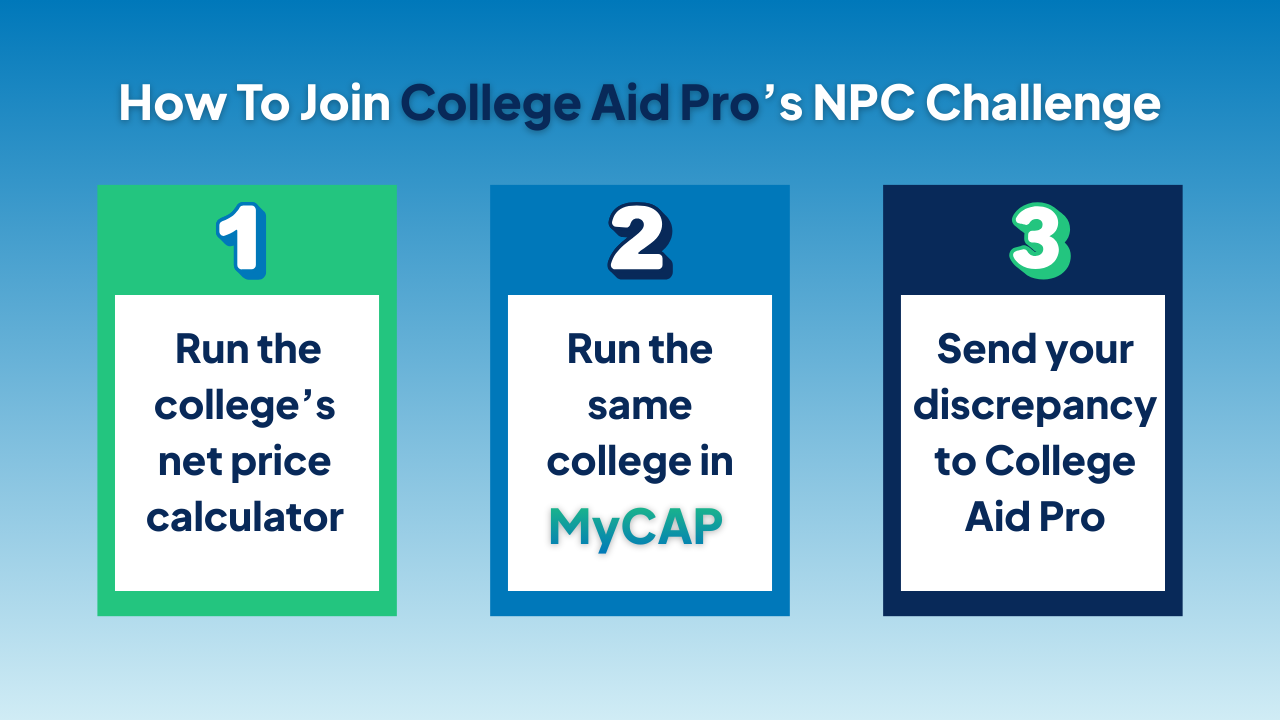
Here’s how it works:
-
Run the college’s net price calculator on the college’s website.
-
Run the same college in MyCAP (College Aid Pro’s calculator).
-
If there’s a discrepancy, send it to College Aid Pro for analysis.
-
Our data team checks both results—for free.
And here’s the kicker:
✅ If the college’s NPC is more accurate than College Aid Pro’s projection, College Aid Pro pays the user $100.
Yes—really.
They even joked: if a student finds five schools where the college NPC beats College Aid Pro, that student could make $500.
Why would a company do that?
Because if the college NPC is right, that’s valuable feedback. It helps College Aid Pro update their model and become more accurate at that school going forward.
The Big Problem: Most NPCs Aren’t Updated
College Aid Pro shared results from an internal audit of roughly 4,000 colleges. One of the most alarming findings:
-
Only a small percentage of NPCs were up-to-date on cost of attendance
-
A huge portion were outdated by two years or more
Even if a calculator had perfect logic (it usually doesn’t), it can’t be accurate if the price inputs are wrong.
And importantly: there’s no enforcement mechanism. Colleges are required to have an NPC, but there’s no meaningful watchdog ensuring it stays accurate.
Another Hidden Issue: Colleges Don’t Build Their Own NPCs
One of the most surprising points in the event:
Colleges typically do not create their own net price calculators.
They use third-party vendors.
That matters because:
-
the calculator logic isn’t customized well to the school’s real packaging behavior
-
updates don’t always happen in real time
-
families may assume they’re submitting data “to the college,” but they’re often submitting to a vendor platform
This creates confusion and false trust:
“It’s on the college website, so it must be accurate.”
Unfortunately, that’s not how this works.
Merit Aid Is Often Missing Completely
Peggy emphasized one of the biggest “deal-breakers” flaws:
If an NPC doesn’t ask for GPA and test scores, it can’t accurately project merit aid.
That’s huge, because many families who don’t qualify for need-based aid still need discounts to make college possible.
If the calculator doesn’t include merit:
-
families think they’ll pay full price
-
they remove schools from the list prematurely
-
students miss opportunities at schools that might actually be affordable
Divorce and Split Households: NPCs Often Warn They’re Not Accurate
Another common scenario where net price calculators fall apart:
-
divorced families
-
separated households
-
blended families
Often, the fine print essentially says:
“This is not accurate for your situation.”
But families don’t read the fine print (understandably), and the calculator output can be dramatically off.
Peg noted that this isn’t a “rare edge case.” A meaningful percentage of families are navigating split-household dynamics—meaning the NPC’s reliability drops even further for a big chunk of the population.
Why NPC Inaccuracy Can Hurt Families (Even When It Overestimates Cost)
A surprising point from the discussion:
Even when NPCs overestimate the cost (meaning the family might pay less than expected), it can still harm them.
Here’s why:
-
Families might not appeal for additional aid because they think they already “got a great deal.”
-
Or they might remove a school from the list because it looks unaffordable, even though it would have been within reach.
Peggy shared a real-world example: a family was off by $30,000 per year—and the parent later realized they had removed multiple schools unnecessarily because of bad NPC data.
FAFSA SAI vs Institutional Methodology: A Major Confusion Point
Matt also highlighted a major misunderstanding in the affordability process:
Many colleges (especially highly selective private institutions) use Institutional Methodology—not FAFSA methodology—to determine need-based aid.
That means:
-
A family’s federal SAI may be irrelevant for how the school actually awards aid
-
There’s no official “institutional SAI” number families receive like they do with FAFSA
-
Families have nothing clear to anchor their expectations to
This is one reason why “rule-based” thinking like:
Cost of attendance – SAI = need
…doesn’t always match reality.
Out-of-State Public Colleges: When Aid “Rules” Don’t Apply
Matt gave a clear example of how public college policies can override aid assumptions:
A public school might show strong “meet need” statistics, but for out-of-state students, the aid can be drastically different (or essentially nonexistent).
So even if you have:
-
a low Student Aid Index (SAI)
-
high demonstrated need
-
strong eligibility on paper
…the school’s business model may still result in no meaningful need-based aid for non-residents.
That’s why accurate projections require more than just published percentages.
The Best Way to Help Families Right Now
If you’re a counselor, parent, or student, here’s the action plan:
1) Treat NPC results as a starting point—not the answer
Running an NPC isn’t “bad.” The mistake is using it as a final decision-maker.
2) Run at least two projections
Matt’s recommendation was essentially:
College NPC + MyCAP (or another trusted tool) = better clarity.
3) Submit discrepancies
If the two projections don’t match, send it in.
College Aid Pro’s team will evaluate which one is closer—and if College Aid Pro is wrong and the college is right, the user gets paid.
Bottom Line: Transparency Builds Better College Lists
This challenge isn’t just a marketing stunt. It’s trying to solve a real systemic issue:
-
families making decisions on faulty affordability data
-
counselors forced to support a process without trustworthy tools
-
colleges not held accountable for calculator accuracy
The goal is simple:
Help families build college lists based on real affordability—not guesswork.