Your high school senior’s college financial aid offer arrives. You scan the page and see it: a line that says Federal Work Study, somewhere between $1,500 and $4,000. It is listed right next to grants and scholarships, so it looks like the same kind of help.
It is not.
Work study does not lower your college bill. It is a part-time job your student may qualify to work while they are enrolled. The money is earned through a paycheck, not credited to your account.
That distinction matters a lot when you are trying to figure out what a school will actually cost your family.
If you only read one part of this article, read this.
|
7 Simple Truths About Work Study on Your Financial Aid Offer 1. Work study is a job, not a discount. It does not reduce what you owe the school. |
What Is Work Study?
Work study is a federally funded program that helps students pay for college expenses by working part-time jobs, often on campus, while they are enrolled. The jobs are usually flexible around class schedules. Some students even have downtime to study while they are on the clock. That is where the name comes from.
Here is the key thing to understand: work study is a job opportunity, not a financial aid award. The amount listed on your offer is not money the school is giving your student. It is an estimate of what your student could earn if they find and work a qualifying job.
Where Work Study Shows Up on a Financial Aid Offer
This is where the confusion starts for most families.
When your financial aid offer arrives, it typically groups everything together in one table. It might look something like this:
| Type of Aid | Amount |
| Institutional Grant | $12,000 |
| Merit Scholarship | $2,500 |
| Federal Direct Subsidized Loan | $3,500 |
| Federal Direct Unsubsidized Loan | $2,000 |
| Federal Work Study | $3,000 |
| Total Aid Package | $23,000 |
Seeing it laid out like that, it is easy to assume it all works the same way. It does not.
Grants and scholarships reduce your bill directly. Loans have to be repaid with interest. Work study is earned through labor, over time, in a paycheck. Four completely different things, listed side by side with no explanation.
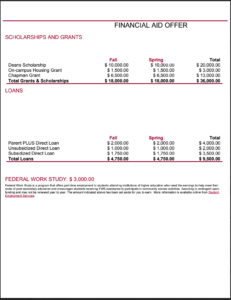
Here’s an example of how it could show up in a financial aid offer from a college.
Does Work Study Lower Your College Bill?
No. Work study does not lower your college bill.
Nothing changes on your bill because work study appears on your financial aid offer. The bill the school sends you reflects what you owe after grants and scholarships are applied. Work study is not part of that calculation.
Here is a direct comparison so you can see exactly how each type of aid works:
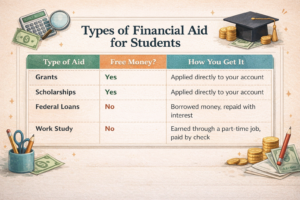
If you are trying to figure out what a school will actually cost your family, you need to separate what reduces your bill from what does not. Work study belongs in the “does not” column.
How Work Study Actually Works
If your student is awarded work study, here is what actually happens next:
- Your student still has to find and apply for a work study position. It is not automatically assigned.
- Once hired, your student earns an hourly wage and receives regular paychecks.
- The money goes directly to your student, not to the school.
- Your student can use those earnings however they choose, including for living expenses, books, or personal costs.
- The amount on the financial aid offer is an estimate. If your student works fewer hours, they earn less.
This is worth repeating: the work study amount on your financial aid offer is an estimate of what your student could earn, not a credit applied to your account.
A Real Example
Your student is offered work study and it’s list on their financial aid offer as $4,000 of “aid.”
Let’s assume your student finds a job that pays $12 an hour. To earn the full $4,000, they would need to work roughly 8 to 10 hours per week across the academic year.
Now think about what freshman year actually looks like. Your student is adjusting to a new environment, a new schedule, and harder coursework. If they:
- Take time to settle in before finding a job
- Work fewer hours during midterms or finals
- Decide the workload is too much to manage alongside their course load
They earn less than $4,000. Maybe significantly less. So that number on the offer is more often a ceiling of what your student could earn, not an amount that you can count on to cover part of your college bill.
Who Qualifies for Work Study?
Work study eligibility is based on financial need, which is determined through the FAFSA. Not every student who files will receive a work study offer, and not every school participates in the federal work study program.
A few things worth knowing:
- Your student must file the FAFSA and check the box indicating interest in work study.
- Checking the box does not guarantee they will receive it, but not checking it means they will not be considered at all.
- Even if your student qualifies, they are not required to accept or use it.
How to Apply for Work Study
The process is straightforward but easy to miss if you are not paying attention.
- File the FAFSA and check the work study box when prompted.
- If awarded work study, look for job listings through the financial aid office or the school’s campus employment portal.
- Apply for available positions and go through the normal hiring process.
- Once hired, you are eligible to work up to the awarded amount.
One thing worth noting: some schools have more work study jobs available than others. At larger universities, competition for positions can be real. A work study award does not mean a job is waiting.
Should You Count Work Study When Comparing Colleges?
Be careful here. Work study is often included in the total aid package a school presents, which can make an offer look more generous than it really is.
When you are comparing financial aid offers across schools, the most useful number is your actual out-of-pocket cost: what the school expects your family to pay, plus any loans. Work study should not factor into that number because it depends entirely on your student finding and keeping a job.
A useful gut check: if work study were not listed on the offer at all, would your evaluation of the school’s affordability change? It should not. The bill is the bill, and work study does not touch it.
Why Work Study Can Still Be Worth It
This is not an argument against work study. For the right student in the right situation, it can be genuinely valuable.
Campus jobs are often flexible. Many supervisors understand that class comes first. Some jobs have enough downtime that students can get studying done while they are on the clock. And beyond the paycheck, students can build relationships, gain work experience, and stay connected to campus life in a way that passive financial aid does not offer.
Work study is a useful tool. It is just not the tool that lowers your college bill.
How to Get Clarity on What Each School Will Actually Cost
Financial aid offers are genuinely confusing. No two schools format them the same way. Some bury loans under the word “aid.” Some include work study in the total without any explanation of how it works. The system is not designed to be easy to read.
The most important thing you can do is separate what reduces your bill from what does not, and compare schools using the same terms.
MyCAP is a tool that helps families do exactly that. You can upload up to three financial aid offers for free and see what each school will actually cost your family, with grants, loans, and work study clearly separated. No guessing. No comparing apples to oranges.
If you are staring at a financial aid offer right now thinking “I do not actually know what this means,” you are not behind. The system is not designed to be transparent. Getting clarity is the whole point.
See what each school will really cost your family at MyCAP. Create your free account here.
Frequently Asked Questions About Work Study
Does work study reduce your college bill?
No. Work study does not reduce your bill or appear as a credit on your student account. It is money earned through a part-time job and paid in a regular paycheck.
Is work study the same as a scholarship?
No. Scholarships and grants reduce what you owe the school directly. Work study is a job. The two are categorically different, even though they often appear on the same financial aid offer.
Does work study show up on your financial aid offer?
Yes, and that is exactly where the confusion comes from. Work study is listed alongside grants and loans in the aid package, which makes it easy to assume it works the same way. It does not.
What happens if my student does not use their work study?
Nothing. If your student does not find a work study job, or works fewer hours than the offered amount, they simply earn less. There is no penalty, and the unused amount does not convert to any other type of aid.
Can my student use work study earnings for anything?
Yes. Work study earnings are paid directly to your student, not to the school. Your student can use the money for living expenses, books, personal costs, or anything else.
Does every school offer federal work study?
No. Not every school participates in the federal work study program. Check with the financial aid office at each school on your list to understand what is available.
Is work study based on financial need?
Yes. Eligibility for federal work study is determined through the FAFSA based on your family’s financial need. Students who do not demonstrate sufficient need may not receive a work study offer.
Can a student decline work study?
Yes. Work study is optional. Declining it does not affect any other part of the financial aid package.
How much can a student realistically earn through work study?
It depends on the hourly wage and hours worked. Most work study positions pay between $10 and $15 per hour. Working 8 to 10 hours per week across an academic year can get a student close to the offered amount, but coursework, adjustment time, and life usually reduce that total.