If your student is about to submit their FAFSA, there is a new step you need to know about first. Our financial aid expert Melissa Mieyr breaks down what changed, what counts as valid ID, and what to do today so a last minute request does not slow down your aid.

New FAFSA Fraud Screening: What Every Family Needs to Know Before They Apply
If your student is submitting their FAFSA soon, there is a new step in the process you need to know about.
What changed
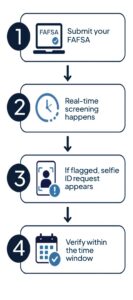
On April 26th, the U.S. Department of Education rolled out real-time identity fraud screening for every single FAFSA application. As soon as a student completes their section and submits, the system automatically assesses fraud risk in the background. Most students will not notice a thing.
But a portion of applicants will be flagged as “high risk.” If that happens, the student is required to verify their identity through a live check: a selfie taken on a smartphone or tablet that the system compares against the photo on their government-issued ID. This must be completed before their application can move forward.
Why this matters more for some families than others
The students most likely to get flagged are often the ones who most need financial aid:
- Students without stable housing
- Students who move frequently
- First-generation students with limited documentation
- Families navigating complex identity paperwork, including immigrant families
If the system flags the wrong people, this does not just stop fraud; it delays or denies access to aid for the exact populations federal financial aid is meant to serve.
What counts as valid ID
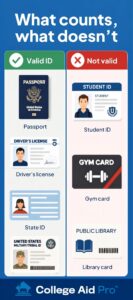
To complete verification, a student needs a valid, unexpired, government-issued photo ID:
- U.S. passport or passport card
- State driver’s license (any state, D.C., or U.S. territory)
- State-issued non-driver photo ID
- Certain tribal IDs, military IDs, or permanent resident cards
What does NOT count
- Student ID cards
- Temporary driver’s licenses
- Store, company, or membership cards
- Library or gym cards
Two very important details for families
There is a limited window (only a few minutes) for a flagged student to provide ID verification once it is requested. The Department of Education has not specified exactly how long that window is.
Students only get one chance to complete this. If verification is not provided within that time limit, they cannot just log back in later or the next day to try again. The student may then need to resolve their identity issue individually with each college they are applying to, since schools are not required to accept another institution’s identity confirmation. This can mean manual follow-up with more than one college, slowing the process at a time when deadlines are already tight.
What happens if a student is flagged
- Screening happens after the student completes their section of the FAFSA and invites contributors.
- Parent contributors can still receive their invitation and complete their sections even if the student has been flagged.
- If identity cannot be confirmed through the online process, the FAFSA may be held until it is verified through each school’s own identity verification procedure.
What to do today—before your student even applies
- Check your student’s ID. Is it valid or is it expired? If it’s expired, start the process to get or renew one now; depending on the documentation required, this can take weeks.
- Make sure your student has their phone or tablet ready at the time your family submits their FAFSA, in case verification is requested on the spot.
- Do not wait until aid is on the line. A delayed FAFSA can mean a delayed financial aid offer, which can affect a family’s ability to compare costs and make a decision by school deadlines.
The bottom line
This new layer of fraud screening is meant to protect the integrity of federal student aid, but it also raises the stakes for families who are already navigating a complicated system. A few minutes of preparation now (confirming ID, having a device on hand) can prevent a serious delay later.
If you have questions about how this affects your family, Melissa and the College Aid Pro team are here to help.
Source: U.S. Department of Education, official announcement. This post is general information, not legal advice. Families need to reach out to the appropriate parties to resolve any identification issues.
Screenshots of what the verification process will look like: FAFSA verification screenshots (PDF)
About Melissa Mieyr, M.Ed.
Melissa Mieyr is a college and financial consultant with more than 24 years of experience in public education, including 15 years supporting a high school counseling office and helping students and families navigate the college planning process. A certified school counselor and school administrator, she brings extensive experience in education and college planning to her work with families.
As founder of InfoQuest College & Financial Solutions, LLC, Melissa specializes in college affordability and financial aid, helping families make informed decisions about the financial implications of college. She also serves as a financial aid professional with College Aid Pro, working with families using its financial planning tools and methodology.
Melissa is committed to advancing financial-aid knowledge within the educational consulting profession through her service on affordability committees with Higher Education Consultants Association (HECA) and Independent Educational Consultants Association (IECA), where she educates and supports fellow educational consultants on college affordability and financial aid.
Schedule a consult with Melissa here.
Frequently Asked Questions
What is FAFSA identity verification? It’s a real-time fraud screening the Department of Education added to the FAFSA on April 26, 2026. Every application is automatically checked in the background, and a small percentage of students are flagged for an extra step: a live selfie check against their government-issued photo ID.
What ID counts for FAFSA verification? A valid, unexpired, government-issued photo ID such as a U.S. passport, state driver’s license, state non-driver ID, or certain tribal, military, or permanent resident IDs. Student IDs, gym cards, and temporary licenses do not count.
How long do students have to verify their identity if flagged? Only a few minutes once verification is requested, and only one attempt. The Department of Education has not published an exact time limit.
What happens if a student can’t verify their identity in time? The FAFSA may be held, and the student may need to resolve the issue directly with each college they’re applying to, since schools aren’t required to accept another school’s identity confirmation.
Does this affect parent contributors? No. Parent contributors can still complete their section of the FAFSA even if the student has been flagged for identity verification.